How the Manaus Free Trade Zone Works
How the Manaus Free Trade Zone Works
The Manaus Free Trade Zone is one of the most important industrial development models in Brazil. Created in the 1960s and strengthened by Decree-Law 288 of 1967, its existence is guaranteed by the Constitution until 2073, ensuring security for long-term investments.
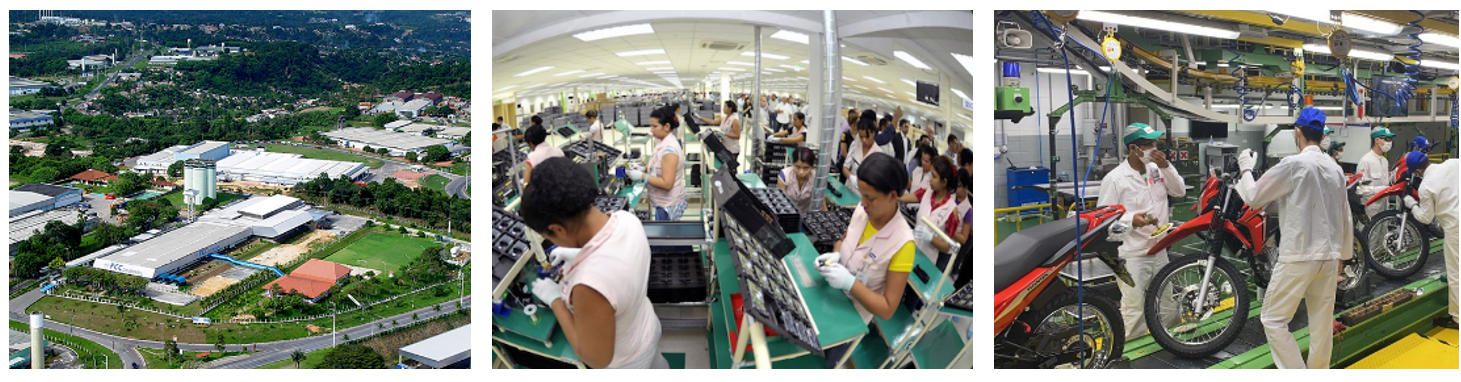
Managed by the federal agency Suframa, the Free Trade Zone transformed Manaus into the country's main electronics and consumer goods hub, bringing together companies such as Samsung, LG, Philco, Honda, Yamaha, TCL and dozens of manufacturers that form a robust ecosystem of technology and manufacturing.
Why the Free Trade Zone Exists
The goal is to develop the Amazon region by creating qualified jobs, attracting technology, reducing regional inequalities, and building a strategic industrial hub for the country.
The combination of tax incentives and clear manufacturing rules has made Manaus a highly competitive location for producing electronics, motorcycles, air conditioners, IT products, and hundreds of other items.
Main Incentives of the Manaus Free Trade Zone
Federal Incentives
Regulated by the federal government and applied by the Brazilian Federal Revenue Service:
• exemption or reduction of Import Tax on inputs
• exemption of IPI on finished products
• PIS/COFINS reductions
• simplified regime for industrial machinery and equipment
Official sources: MDIC and MCTI.
State Incentives from Amazonas
Regulated by SEFAZ-AM:
• ICMS stimulus credits
• ICMS deferral on entry
• incentives for industrial expansion
These state incentives are among the strongest in the country.
How Taxes and Incentives Work in the Free Trade Zone
The table below objectively presents how taxation and incentives apply to each type of operation within the Manaus Free Trade Zone.
| Operation Type | Import Tax | IPI | PIS COFINS | ICMS AM | Notes |
| Importing parts and components to manufacture in Manaus | Exempt or reduced | Exempt | Strong reduction | High state incentives | Main industrial advantage |
| Importing finished products to sell in Manaus | Usually charged | Small reductions | Limited benefits | Reduced benefits | Commercial operation is not the focus |
| Manufacturing in Manaus and selling to other states | Not applicable | Exempt | High benefits | ICMS credits and reductions | Most common model for large factories |
| Manufacturing and selling within Amazonas | Not applicable | Exempt | Reductions | State incentives | Stimulates internal consumption |
| Importing machinery and equipment for factory use | Significant reduction | Exempt | Reduction | State reductions | Facilitates production line setup |
What the PPB Is and Why It Is the Key to the Entire Model
The Basic Productive Process (PPB) is the minimum set of manufacturing steps a company must perform in Brazil in order to access the incentives. It exists to ensure real industrialization instead of simple superficial assembly.
The PPB is published through joint Interministerial Ordinances from MDIC and MCTI.
How the PPB Works
The PPB defines the minimum mandatory operations for each product, including:
• PCB soldering and assembly
• module and subassembly assembly
• plastic injection of casings
• functional and electrical testing
• firmware programming
• industrial packaging with tracking
The company must perform all steps and maintain periodic technical reports.
How the PPB Is Approved
1 company submits the technical project to Suframa
2 local technical analysis
3 submission to MDIC and MCTI
4 official publication of the Ordinance
5 ongoing audits and monitoring
If the PPB is not met, tax benefits are immediately suspended.
PPB and NCM: How the Relationship Works
The NCM is the tax classification.
The PPB is the manufacturing rule.
Both must match perfectly.
• each NCM has a corresponding PPB or not
• if a PPB exists and the company does not follow it, it loses the incentive
• if the NCM is incorrect, the product cannot use the incentive
The NCM opens the door.
The PPB grants the benefit.
SKD, CKD, and Finished Products in the Manaus Model
The way a product enters Brazil determines how it fits within the PPB.
Finished Product
No disassembly. Does not meet PPB. Does not receive incentives.
SKD
Semi-disassembled product. Reduced manufacturing stages in Brazil. Can be used only in initial phases.
CKD
Fully disassembled product. Several assembly stages in Brazil. Ideal model for PPB compliance.
In the Manaus Industrial Hub, companies generally start with SKD and evolve to CKD as the PPB requires increased nationalization.
Real Examples of PPBs Used in Manaus
Televisions
• board assembly
• panel insertion
• casing
• image testing
• firmware
• packaging
Smartphones
• SMD soldering
• camera modules
• RF testing
• IMEI programming
• functional tests
Laptops
• motherboard
• storage
• display
• operating system
• final tests
Air Conditioners
• indoor and outdoor modules
• gas filling
• leak tests
• performance tests
Motorcycles
• full assembly
• electrical system
• wheels
• transmission
• road testing
These PPBs ensure real industrialization and job creation.
Why Manaus Dominates National Production
While other free trade areas offer limited benefits focused on commerce, Manaus has:
• strong federal incentives
• very aggressive state incentives
• a consolidated industrial cluster
• local suppliers
• specialized labor
• decades of structural investment
That is why almost all electronics sold in Brazil are manufactured in the Manaus Industrial Hub.
Conclusion
The Manaus Free Trade Zone is a robust industrial development model. It works because it combines relevant tax incentives with strict productive rules defined by the PPB. This ensures that Brazil gains qualified jobs, technology, local suppliers, and industrial capacity in several strategic sectors.
The model remains one of the pillars of the Brazilian economy and a successful example of industrial policy capable of transforming an entire region.
Related Blog